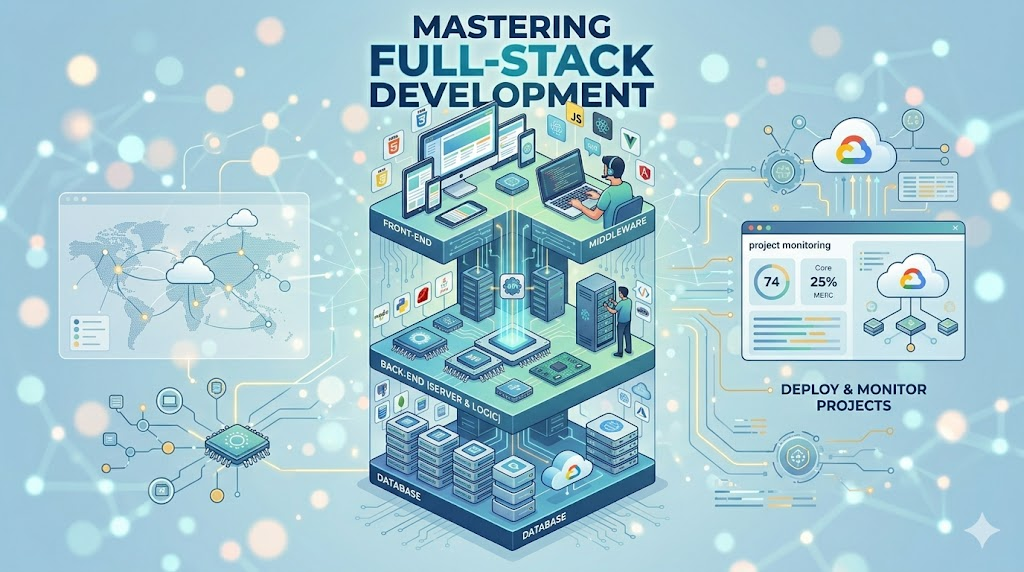
The landscape of modern software engineering in the United States has shifted dramatically toward the “T-shaped” professional—someone with deep expertise in one area and a broad understanding of the entire stack. For students across US state universities, the journey to becoming a full-stack developer is no longer a linear path but a complex multidimensional challenge. Mastering the stack requires a deep understanding of front-end aesthetics, back-end efficiency, and the critical middleware that binds them together. In an era where Generative AI is reshaping how code is written, the human element—strategic architecture and logic—remains the true differentiator in the job market.
Recognizing when to delegate non-core tasks is a hallmark of a senior-level mindset. For many students navigating the intense pressure of a 4-year degree alongside specialized coding bootcamps, the decision to pay for homework in elective subjects is a strategic move. This preserves mental energy for the grueling demands of a Full-Stack Capstone project that will eventually serve as their professional calling card.
Navigating the Tech Curriculum with a Professional Coursework Writing Service
The academic reality in the US often places students under immense pressure, particularly when balancing a 20-unit semester with high-stakes coding labs. To maintain a competitive GPA while building a robust GitHub portfolio, many students opt for a specialized coursework writing service in the USA. This allows them to ensure their theoretical documentation and research papers meet the rigorous standards of American institutions without sacrificing the deep-work hours required to debug complex microservices or optimize database queries.
The Context-Switching Challenge in US Universities
American students often face the unique challenge of “context-switching” between radically different disciplines. The cognitive load required to jump from a React component to a historical analysis essay can derail a developer’s flow state for hours. Below is a comparison of the average weekly time commitment for typical undergraduate tasks in US tech programs:
| Task Category | Average Hours Per Week | Cognitive Load |
| Full-Stack Project (Coding/Debug) | 18–25 Hours | Very High |
| Lab Reports & Documentation | 6–8 Hours | High |
| General Education / History Essay | 4–5 Hours | Moderate |
| Technical Research & Reading | 5–7 Hours | High |
1. The Full-Stack Spectrum: Prioritizing Your Learning Path
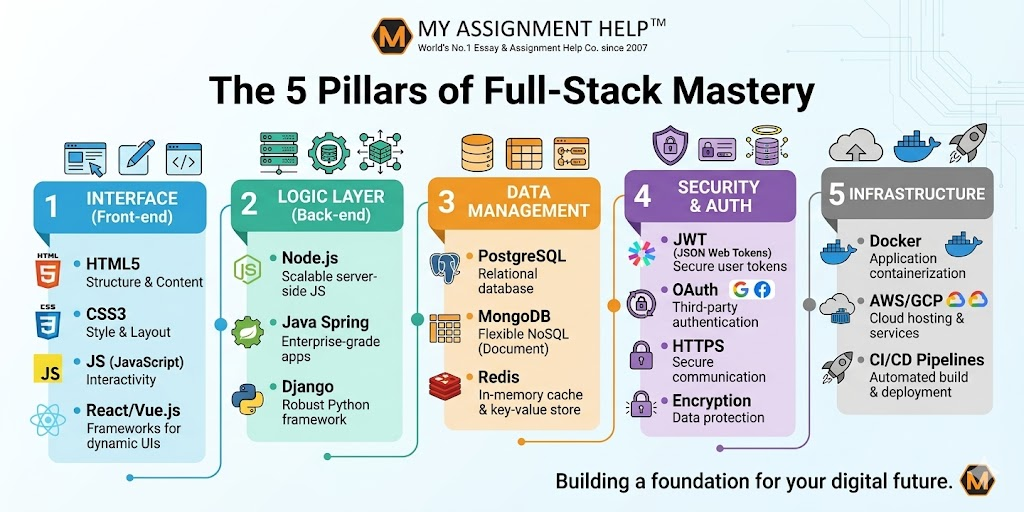
Full-stack development is vast, covering everything from UI/UX design to DevOps. In the USA, the current market heavily favors the MERN (MongoDB, Express, React, Node) and Java/Spring Boot ecosystems. According to the 2026 Stack Overflow Developer Survey, nearly 52% of professional developers identify as full-stack, yet the majority of computer science graduates feel underprepared for the deployment phase of software engineering.
The Front-End: User-Centric Engineering
Modern US standards focus on accessibility (ADA compliance) and performance. Mastering frameworks like React is essential, but understanding the underlying JavaScript (ES6+) and state management (Redux/Context API) is what defines a master. Your academic projects must reflect these industry-standard practices to be viable for internships at major US tech firms.
The Back-End: Robust Logic and Security
The back-end is the engine room. Whether you are using Python, Java, or JavaScript on the server side, your focus must be on security and scalability. Implementing OAuth 2.0, JWT (JSON Web Tokens), and RESTful API standards is non-negotiable in the American tech sector.
2. Advanced Strategies for Deadline Management
Managing a programming project is inherently different from managing a written assignment. Code is fragile; a single semicolon can halt progress. To survive a US CS degree, you must adopt professional project management methodologies like Agile and Scrum.
- The “Agile” Student Workflow: Break your project into two-week “sprints”. Define your Minimum Viable Product (MVP) early.
- Version Control: Using GitHub or GitLab for every assignment prevents catastrophic data loss and demonstrates a professional workflow to potential employers.
- Strategic Delegation: Use professional writing services for non-technical assignments to keep your focus on core engineering.
Key Takeaways for US Students
- Master One Stack First: Focus on MERN or Java/Spring before expanding.
- Delegate Strategically: Use support for non-core tasks to preserve coding energy.
- Prioritize Security: Modern US roles require deep knowledge of authentication.
- Build for the User: Keep ADA compliance and responsive design at the forefront.
Frequently Asked Questions (FAQ)
Q: Is it better to specialize or become a full-stack developer?
In the current US job market, full-stack developers have higher versatility and are often preferred by startups and mid-sized firms.
Q: How do I handle burnout during finals week with multiple coding labs?
Implement the 50/10 rule: 50 minutes of deep coding followed by a 10-minute complete break. Additionally, outsource non-essential coursework to maintain your mental health.
Q: What is the most demanded back-end language in the USA?
Java remains the powerhouse for enterprise systems, while JavaScript (Node.js) and Python are dominant in the agile and data-driven sectors.
References and Sources
- U.S. Bureau of Labor Statistics (2026): Software Developers Occupational Outlook.
- IEEE Computer Society (2026): Trends in Full-Stack Web Development Education.
- Stack Overflow Global Developer Survey (2026): Tech Ecosystem Rankings.
- ACM (Association for Computing Machinery): Guidelines for Undergraduate CS Programs.
About the Author: Kara Betty, a Senior Content Strategist at MyAssignmentHelp. With extensive experience in the American academic landscape, the author focuses on providing actionable insights for STEM students, helping them navigate the intersection of professional skill development and academic rigor.